RESEARCH

UCSD & Qualcomm Institute - Digital Twins

A digital twin is set of adaptive models that emulate the behaviour of a physical system in a virtual system getting real time data to update itself along its life cycle. The digital twin replicates the physical system to predict failures and opportunities for changing, to prescribe real time actions for optimizing and/or mitigating unexpected events observing and evaluating the operating profile system.

We have partnered up with Smart City Labs and the Qualcomm Institute to deliver next Gen Smart Cities . . . 3D + IoT + Drones + Energy.

Netload

The U.S. Department of Energy (DOE) has one of the richest and most diverse histories in the federal government. Although only in existence since 1977, the Department traces its lineage to the Manhattan Project effort to develop the atomic bomb during World War II and to the various energy-related programs that previously had been dispersed throughout various federal agencies.

The goal here is to be able to forecast/predict the realtime load at a substation. If this can be achieved CCA’s/Clients/Generators can create a more accurate load balance.

Walmart - Baselining, Design and Modeling

The Baseline Period Measurement and Verification Plan, prepared by the Center for Sustainable Energy, defines the baseline energy and water performance of the site including which building and system components will be monitored, the monitoring interval and period, the equipment necessary to obtain the required data, and other details related to equipment installation planning.

“Locbit is a cloud-based control system accessible through authorized local, remote, and mobile devices. The control system monitors all connected building systems and detects energy waste, equipment malfunctions, and other operational problems using a fault detection and diagnostics engine. The largest innovation on this project was the integration of all technology vendor system data, plus the legacy Walmart control system from Honeywell, all in a single platform that streamlines data collection and enhances visibility into store equipment operations.”

Also, please note, Locbit, Inc. did not get control only read capabilities.

The project team will design and install a holistic suite of pre-commercial energy efficiency (EE) technologies for the Covina Walmart building. P2S will design the energy efficiency technology package and prepare a basis of design, design documents and construction documents.

To inform the energy efficiency technology package selected, NREL used the Department of Energy’s OpenStudio Modeling Software to complete baseline and calibrated energy models. They also performed an optimization study whereby the baseline energy model is run with various energy efficiency technology packages.

Each energy efficiency package will include different combinations of precommercial technologies to determine the best energy efficiency package, as well as the best scheduling of technologies when interacting with one another. Additionally, the final calibrated energy model will be utilized for comparison during a set measurement and verification period after the installation of all selected technologies.

Energy Prediction Algorithm

This is a machine learning-based energy prediction algorithm, aimed at forecasting power consumption using historical data and weather conditions. The goal is to enhance automation and optimize battery discharge to reduce peak power costs. Several models were tested, including Linear Regression, Random Forest, XGBoost, and various Neural Networks, with results varying across different business cases (e.g., Zion, Stellar Care, and Sweet Water Gas). The study highlights challenges of seasonal variations and occupancy effects, with XGBoost and regression models showing the best performance.

Please note, the models do not matter, as long as there are recursive feedback loops . . .and standardized data. In turn, we can pick and adjust the best models and deploy them. The models can even change each day!

OpenADR

OpenADR is a standard for automating demand response in energy management, helping utilities and customers optimize electricity use.

Load Shedding Capacity

Developed a machine learning-based energy prediction system to forecast daily power consumption using historical usage data and weather features, enabling automated demand response and cost optimization for businesses per site basis.

If you can predict the energy use at business location and pair it with substation load predictions and generations . . . more efficient power systems can be developed.

3D Printing

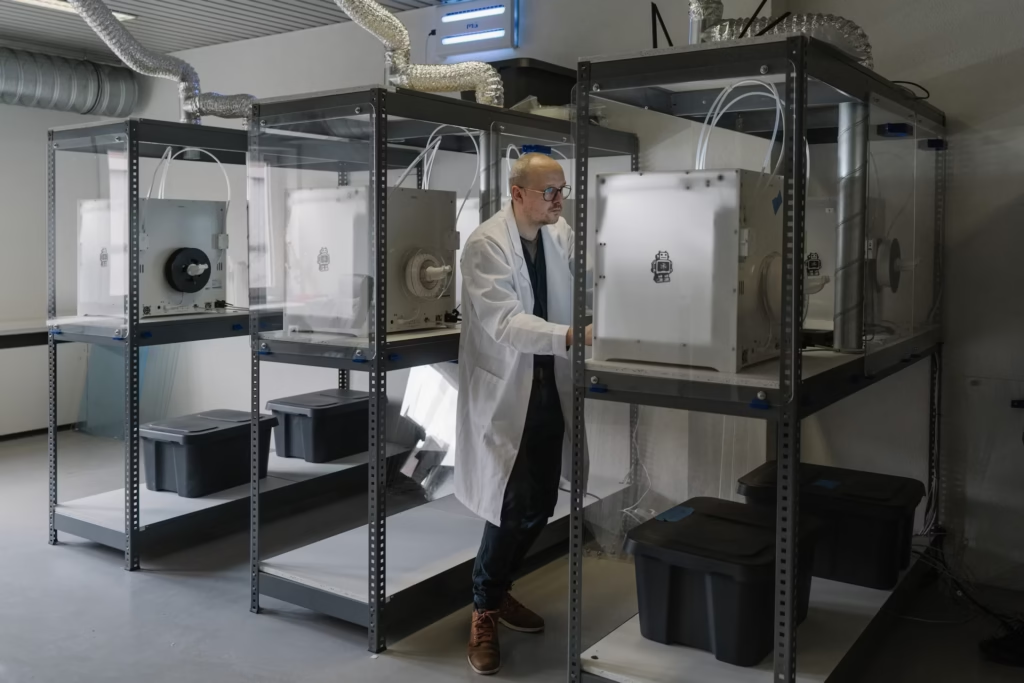
Developed a basic integration with Octoprint and the Locbit System. 3D Printing + Energy Optimization + Ai = Interesting Outcomes.

What if Businesses had the capability to print their needs according to demand . . . onsite in energy efficient manners.

GitHub

Please visit our GitHub and See things we worked on through out the years.

Scroll to Top